
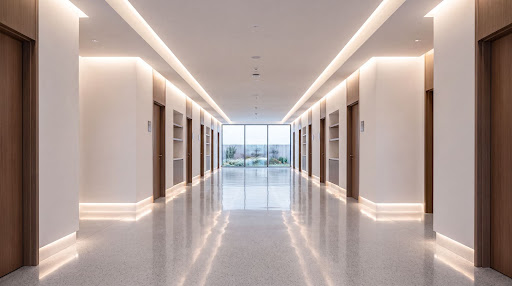
When choosing flooring materials for a healthcare clinic or medical setting, durability as well as strong moisture resistance, hygiene, cleanability, and acoustic performance are key factors to consider. Flooring that looks attractive and performs well in retail or other general commercial settings (such as reclaimed hardwood or broadloom carpet) may not be suitable for this more demanding environment. Meanwhile, foyers, hallways, and examination suites must still convey an appealing, modern, clean, and welcoming aesthetic. This can put extra pressure on a critical selection process.
At Ozburn-Hessey, we bring more than 30 years of flooring selection and installation expertise to every project. We help healthcare decision-makers evaluate not only how a material looks, but also how it will respond to rolling equipment, intensive cleaning, moisture, heavy foot traffic, and the demands of daily clinical operations.
Let’s look at the most common flooring types for medical clinics and healthcare settings in Nashville, and how to determine which products belong in which areas.
What Is the Best Flooring for a Medical Clinic?
There is no single product that qualifies as the best medical flooring for every room. A successful choice usually combines several materials according to the function, risk level, traffic, maintenance protocol, and atmosphere of each space.
Sheet vinyl is one of the strongest choices for examination rooms, treatment areas, laboratories, and other clinical spaces that require a smooth, easy-to-clean surface. With this flooring type, seams can be heat-welded, and sheet lengths can be curved several inches up the wall, creating a smooth transition without the hard-to-clean joints typically found between flooring and baseboards. This does not make a room sterile, but it creates a smooth surface that supports effective cleaning and disinfection. It’s important to note that the cleaning products used on these surfaces must be compatible with the facility’s cleaning and disinfecting chemicals. Repeated exposure to an unsuitable product can discolor the flooring, damage its protective finish, or weaken its seams and adhesives, reducing its performance and service life.
Commercial-grade LVT and LVP are frequently used as flooring for medical offices, including waiting rooms, reception areas, corridors, consultation rooms, and administrative spaces. These materials can reproduce the appearance of wood or stone while offering easier maintenance than the natural materials they resemble.
LVT and LVP should be selected based on more than just appearance. The product must have a protective wear layer suited to heavy traffic, resist permanent indentations caused by furniture and equipment, and tolerate repeated movement by wheelchairs and medical carts. Its seams must also be properly installed to limit dirt and moisture seepage, while its surface should be able to withstand the cleaning products and disinfectants used by the facility.
Commercial rubber flooring is particularly well suited to rehabilitation spaces, nurse stations, pharmacies, and other areas where people are on their feet for extended periods. Its dense, nonporous surface supports effective cleaning, while latex-free formulations are available for facilities with specific material requirements. Rubber’s resilience can improve underfoot comfort, and its sound-dampening properties help reduce noise from footsteps and rolling traffic. Slip resistance, however, depends on the specific product, surface texture, the facility’s cleaning program, and the conditions under which the flooring will be used.
Porcelain and ceramic tile may be appropriate for public restrooms, cafeterias, and some wet or utility spaces because they resist water and wear. Grout selection is critical, however. High-performance grout can offer better stain and chemical resistance than conventional cementitious products. Bear in mind that tile is also hard underfoot and contains numerous joints. It is therefore more selectively used than resilient medical vinyl flooring in treatment environments.
Carpeting Is Not Recommended for Most Clinical Settings
Clinical flooring must be smooth, durable, cleanable, and capable of withstanding repeated exposure to the facility’s cleaning and disinfecting products. Information from the Facility Guidelines Institute emphasizes that flooring in these environments must be stable, firm, slip-resistant, wear-resistant, and appropriate for the location.
For these reasons, carpet does not make our list of recommendations. While it can soften the appearance of administrative offices, counseling rooms, and certain waiting areas, and can help control noise, it is a poor choice for areas where immunocompromised patients are present. It is also a poor choice for spaces exposed to frequent spills, biological contamination, or heavy wet cleaning.
In healthcare design, the room’s function should always guide the material decision. If you hope to integrate carpet into your foyer or consultation area, schedule a consultation with our team at Ozburn-Hessey to ensure your choice aligns with important policies and priorities.
Designing for Safety, Comfort, and Nashville’s Climate
Effective healthcare flooring must support patients, staff, equipment, and facility operations simultaneously. Transitions should be smooth and accessible for wheelchairs, walkers, carts, and mobile equipment.
Acoustics are also important. Persistent noise from corridors and equipment can add to an already stressful environment. For this reason, resilient materials such as rubber and certain acoustically backed vinyl products are great choices for these spaces. Color and pattern choices can help distinguish departments, indicate where patients and visitors should proceed, and make a clinic feel less institutional.
Nashville’s climate is a distinct but equally important consideration when choosing your flooring. Rainwater, grit, and debris tracked indoors can abrade finishes and increase the risk of slips. Meanwhile, Middle Tennessee’s warm, humid conditions make moisture management especially critical. Proper entrance systems, cleaning protocols, and flooring selected for real-life traffic conditions help protect both safety and service life. This is why we again emphasize the importance of consulting with flooring experts before committing to a specific flooring type. There’s a lot to evaluate, and getting it wrong can be as disruptive as it is expensive.
How Subfloor Preparation Determines Flooring Performance
Even the best finish material will fail over an unsuitable substrate. Concrete slabs are common in Nashville clinics, hospitals, and multistory medical buildings, and they must be flat, sound, clean, and properly prepared before the visible flooring is installed.
Concrete is porous, but that does not mean every project simply requires a sheet of plastic beneath the finished floor. Installers must evaluate the existing slab, flooring system, adhesive, and manufacturer requirements. Industry methods include in situ relative humidity testing and calcium chloride testing, where appropriate. If results exceed the flooring or adhesive manufacturer’s limits, an approved moisture-mitigation system may be necessary.
Residual adhesive, curing compounds, cracks, surface irregularities, and incompatible patching materials can all contribute to bubbling, discoloration, indentation, bond failure, or visible imperfections when subflooring is not properly prepared. Self-leveling and patching compounds may be used to create the smooth surface required for sheet vinyl and other resilient products, but they must be compatible with the complete assembly. Your subfloor evaluation should therefore occur early in the process, before flooring materials are ordered.
Local Experience and a Passion for Perfection: That’s Ozburn-Hessey
Choosing an experienced healthcare flooring contractor is the glue that connects every stage of your project, from product selection to moisture testing, substrate preparation, installation, and maintenance guidance.
Family-owned and operated since 1953, Ozburn-Hessey has installed commercial flooring for hospitals, medical offices, universities, hotels, restaurants, libraries, and corporate environments throughout Nashville and Middle Tennessee. Our experience in the healthcare sector includes work for Baptist Hospital and Centennial Hospital, and we’ve also installed floors for such prominent Nashville institutions as the Country Music Hall of Fame and Vanderbilt University’s McGugin Center.
We know that every facility presents a different operational challenge, and no two environments are alike. Our team works closely with our clients to understand their goals, how the rooms they’re renovating or building will function, and how to select flooring that will endure long after the project is complete.
Creating a Healthy and Durable Healthcare Space With the Right Flooring
The right healthcare floor is not simply attractive. It must support sanitation protocols, safely accommodate high foot traffic, optimize staff comfort, offer acoustic control, efficient maintenance, and provide a welcoming aesthetic. Adhering to these criteria results in the proper product selection and installation protocols, and there’s no better partner than Ozburn-Hessey to guide you through the process.
If you’re planning a medical office, clinic, or healthcare renovation in Middle Tennessee, contact Ozburn-Hessey. We’ll help you choose from flooring solutions designed around your facility, operational requirements, and long-term goals.
Request a custom quote today.