
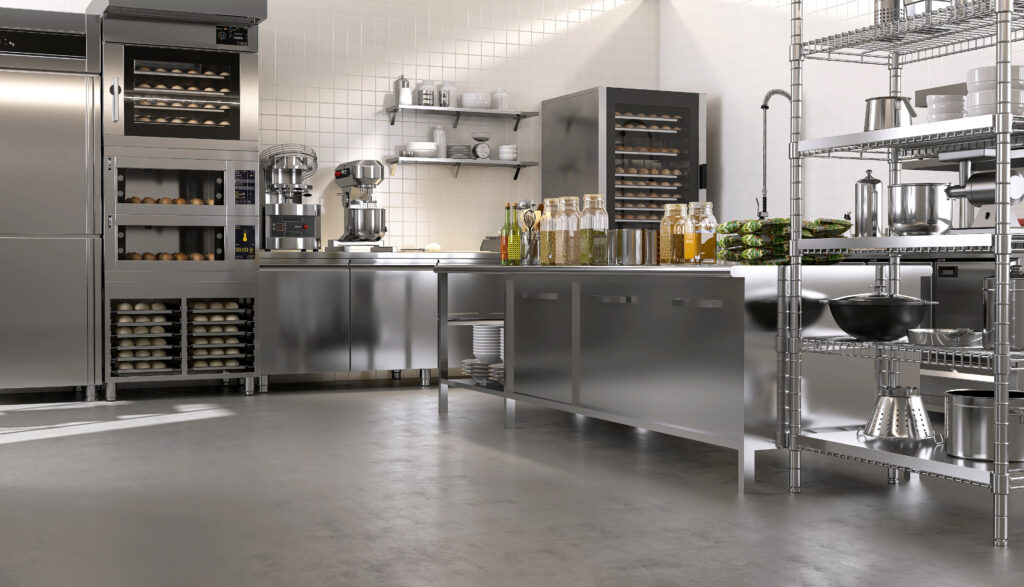
Vinyl and linoleum are resilient surfaces widely used in high-traffic settings, but which is best for commercial kitchen flooring?
The right choice hinges on safety, durability, and hygiene to start, but it also needs to resist grease and spills, and function properly in extreme temperatures. While this is a lot to consider, the wrong choice will reveal itself very quickly. No unsealed concrete, ceramic tiles, or hardwood under these conditions!
At Ozburn-Hessey, we specialize in commercial kitchen floors that are thermal-shock and chemical-resistant, non-slip, easy to clean, and compliant with health codes. We also understand that budgets and timelines are important, which is why we prioritize meeting your goals with flawless attention to detail. It’s what we’re known for among Nashville businesses (and homeowners, too) and why we’ve become the region’s go-to floor and ceiling tile installation experts.
What Commercial Kitchens Really Need From Their Flooring
For busy commercial kitchens, flooring that is waterproof, highly durable, slip-resistant, and easy to maintain is just the beginning. You’ll also need to assess cost, installation, longevity, noise reduction, compliance, and substrate compatibility.
And when your equipment includes gas ovens, fryers, and griddles that operate at high temperatures, your flooring must be heat-resistant.
Both vinyl and linoleum can take a beating and keep on kicking, which is why they’re both popular choices in restaurant, school, and healthcare kitchen environments.
Whether you’re renovating worn and tired kitchen interiors or starting fresh in a brand-new space, our technicians can guide you through the product choice and installation process for the best returns on your investment.
Linoleum Flooring: A Time-Honored Stalwart
What’s interesting about linoleum and vinyl is that it’s difficult to see the difference between them just by looking at a picture. But linoleum has telltale characteristics (and history).
Between the two, linoleum is the older material, originally made from linseed and pine resins, which make it naturally antimicrobial. It’s a durable, solid-color flooring that won’t fade and is water-resistant but not waterproof. This means it can be more prone to buckling or cracking in wet spaces.
When it comes to heat resistance, linoleum edges out vinyl, but only in very extreme conditions (e.g., 200-degree environments). It’s also slightly softer underfoot, which can help reduce fatigue, and is easy to care for, with little more than a broom or pH-appropriate wet solution needed to keep it clean. Well-cared-for linoleum can last 20–40 years; however, it may need periodic sealing.
Commercial Vinyl Flooring: Built for Performance
Today’s selection of vinyl tile flooring is ideal for commercial kitchens. Modern vinyl surfaces are fully waterproof, spill-resistant, and resistant to stains from oil, sauces, and other liquids, making them a frontrunner for restaurant, school, and healthcare kitchens.
Vinyl tile and sheet vinyl can also be heat-welded at the seams to create a watertight surface, which helps preserve subflooring. Linoleum can also be heat-welded for water resistance, but since it’s a thermobond rather than a true fusion, leaks could occur if it’s not installed correctly.
Commercial vinyl is hygienic and non-porous, with many products engineered with antibacterial treatments for optimal commercial kitchen cleanliness. It’s easy to install and can often be laid over existing substrates, reducing operational disruptions.
Routine sweeping and damp mopping are all that’s needed to keep commercial vinyl clean and kitchen-worthy for 10 to 20 years.
Why Professional Installation Is Crucial in Commercial Kitchens
Even the highest-performing flooring can fail in a commercial kitchen if it isn’t installed correctly. Seam integrity, subfloor preparation, slope toward drains, heat-welded joints, and perimeter sealing all need to be executed with care. If transitions, seams, and edges aren’t properly sealed, water can pool, and bacteria can migrate beneath the surface, compromising both hygiene and the floor’s lifespan.
Partner With the Experts at Ozburn-Hessey
When it comes to choosing between linoleum and vinyl for commercial kitchens, we typically recommend vinyl—especially luxury vinyl tile flooring, plank, or sheet vinyl. Vinyl is fully waterproof, requires less maintenance, is easy to install, and costs less.
For kitchens where sustainability is a top priority, and your kitchen environment is lower in moisture, linoleum is an excellent, long-lasting, and eco-friendly choice.
To ensure you’re investing in the right flooring for your commercial kitchen, partner with the team at Ozburn-Hessey. We bring decades of experience to every project, taking the time to assess your space and needs and to discuss your priorities and goals with you.
Planning a renovation or floor replacement? Don’t settle for anything less than the best. Get in touch with us at Ozburn-Hessey for your custom quote today.